Water in Your Crawl Space After Rain: What’s Happening and What to Do
If you’ve gotten under your house after a heavy storm and found water down there, or if you’re seeing the signs without actually looking, musty smells, floors that feel softer than usual, humidity that seems worse on the first floor, you’re not alone. Water in the crawl space after rain is one of the most common calls we get in Hampton Roads, and it makes sense why. This region gets hit hard in the summer. When a few inches of rain falls in a short window, a lot of it ends up exactly where you don’t want it.
The good news is that crawl space water intrusion is a solvable problem. The less good news is that it doesn’t solve itself, and the longer it sits, the more work it’s doing to the wood framing and air quality in your home.
Why Water Gets Into Crawl Spaces After Rain
Water finds its way into a crawl space through a few different routes, and understanding which one applies to your home matters for figuring out the right fix.
Surface water intrusion. This is the most straightforward cause. When rain falls faster than the soil around your home can absorb it, water pools against the foundation and eventually finds its way in through cracks, gaps around penetrations, or open crawl space vents. Homes with flat or poorly graded yards, where the ground slopes toward the house rather than away from it, are especially vulnerable. After a heavy summer storm, that water has nowhere to go except down and in.
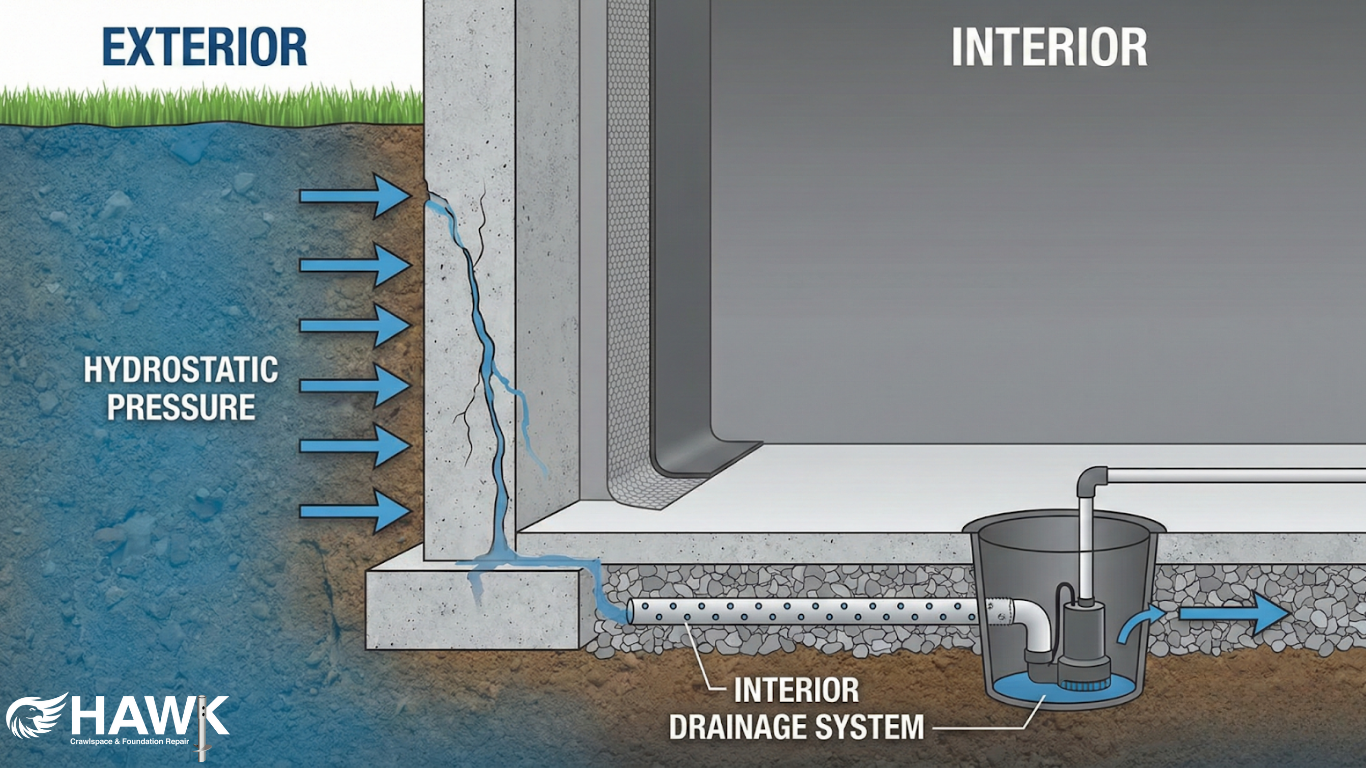
Groundwater and hydrostatic pressure. Hampton Roads sits on coastal plain soil with a water table that in many neighborhoods is only a few feet below the surface. After significant rainfall, that water table rises. When it gets high enough, it pushes upward through the soil floor of the crawl space and through any cracks or gaps in the foundation walls. This is hydrostatic pressure, and it doesn’t require any visible entry point. The water just comes up through the ground. Homes in low-lying parts of Chesapeake, near the waterways in Norfolk, or in any neighborhood that tends to stay soggy after rain are dealing with this regularly. The USGS notes that surface water and groundwater are directly connected, meaning heavy rainfall above ground translates quickly to rising groundwater below it.
Condensation from humid outside air. This one doesn’t require a storm at all, but summer weather makes it worse. Traditional crawl space vents were designed to let outside air circulate under the house. In a climate like coastal Virginia’s, where summer air is hot and saturated with moisture, venting the crawl space just pumps humid air into a cooler space, where it condenses on the wood framing and the ground. After a storm, when outdoor humidity spikes even further, this effect gets worse. It’s a slow drip compared to flooding, but it contributes to the same moisture accumulation over time.
What That Water Is Doing While It Sits There
Water in a crawl space isn’t just an inconvenience. It’s actively working on the structure of your home the whole time it’s down there.
Wood framing, the floor joists, sill plates, and support beams, absorbs moisture from a wet environment even without direct contact. As relative humidity stays elevated, the wood stays damp, and damp wood is exactly the environment that wood-destroying fungi need to establish themselves. Rot doesn’t happen overnight, but a crawl space that floods repeatedly and never fully dries out is accumulating damage with each event. The EPA is clear that mold and wood decay require sustained moisture, and a wet crawl space after every summer storm qualifies as sustained.
Beyond the framing, standing water raises the humidity of the entire crawl space environment. Through the stack effect, where warm air rises through the home and draws air upward from the crawl space, that humid air ends up on your first floor and above. Musty smells, worsening allergies, and air that feels heavier than it should inside the house are all downstream effects of a crawl space that’s holding moisture. The crawl space and the living space above it aren’t as separate as most homeowners assume.
Repeated water intrusion also puts ongoing pressure on the foundation itself. Soil that’s saturated expands and exerts lateral pressure against foundation walls. Over many cycles of wetting and drying, that pressure contributes to cracking and wall movement. It’s a slow process, but it’s directional. Things don’t improve on their own.
What to Check After a Heavy Storm
If you’re comfortable getting into your crawl space, or if you have someone who can, here’s what’s worth looking at after a significant rain event.
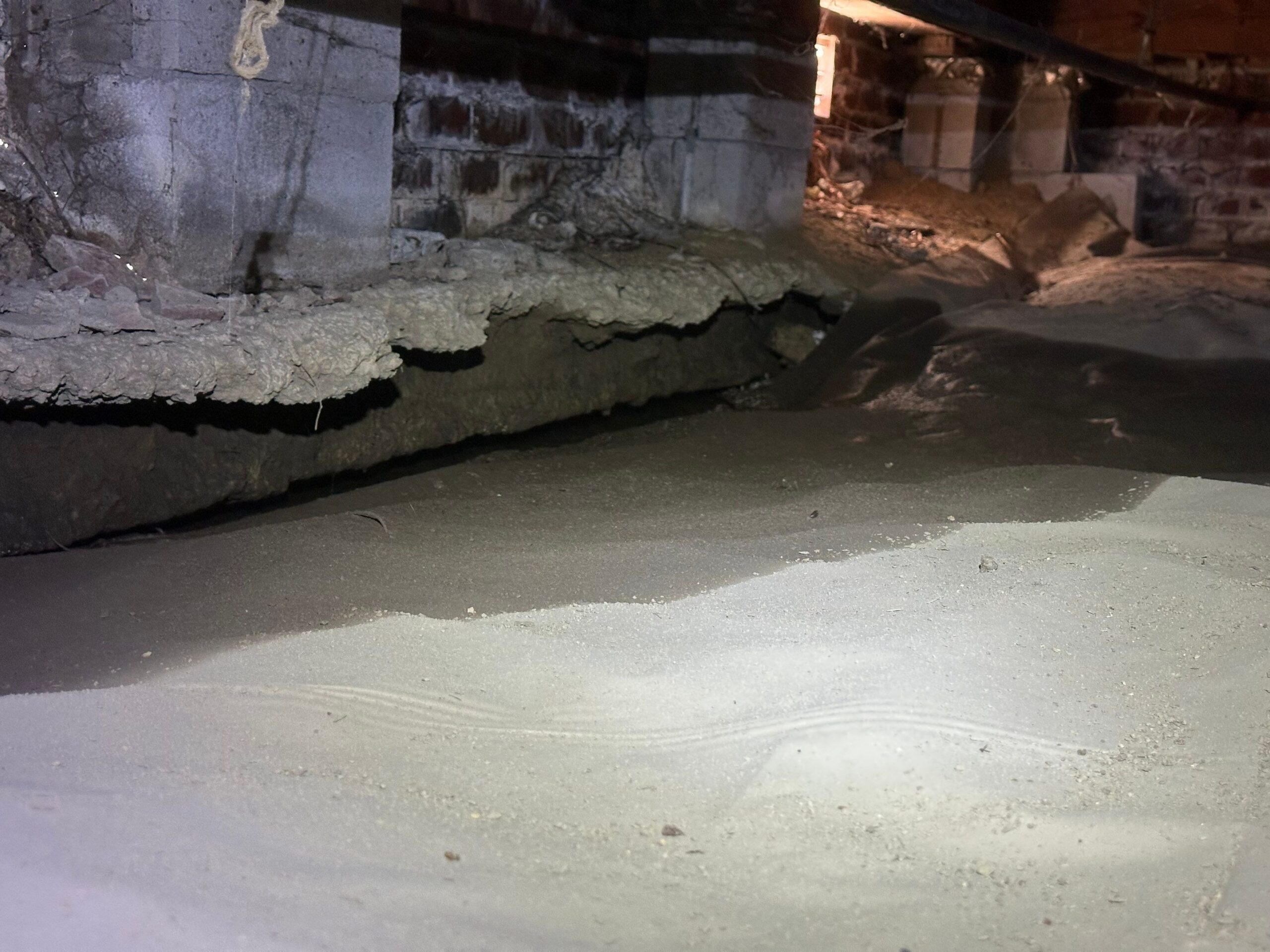
Look for standing water first. Even a shallow layer across part of the crawl space floor is worth noting and addressing. Check the ground near the foundation walls and around any floor drain or sump pit if you have one. If water is pooling near the walls, that’s surface intrusion or hydrostatic pressure at work.
Look at the wood framing, specifically the sill plates along the top of the foundation walls and any floor joists you can see. Dark staining, soft spots, or visible mold growth indicate that moisture has been an ongoing issue, not just a one-storm problem. A screwdriver pushed into the wood with minimal resistance is a sign of rot.
Check whether the existing vapor barrier, if there is one, is intact and in place. Old plastic sheeting tends to tear, bunch up, and separate from the walls over time. A barrier that’s partially covering the ground isn’t doing much.
Outside the house, walk the perimeter and look at how water is moving. Are there areas where it’s pooling against the foundation? Are the gutters and downspouts directing water away from the house, or is it dumping at the base of the wall? Grading and drainage at the surface level have a direct impact on what ends up in the crawl space.
How the Problem Gets Fixed
The right solution depends on where the water is coming from and what condition the crawl space is already in.
For surface water intrusion driven by poor grading or drainage, the fix often starts outside the house: regrading the yard to slope away from the foundation, extending downspout runs, and sometimes installing a French drain system around the perimeter to intercept water before it reaches the foundation. These are unglamorous solutions but effective ones when surface drainage is the root cause.
For groundwater pressure, a sump pump system is usually part of the answer. A properly sized sump pit with a reliable pump actively removes water that would otherwise accumulate under the house. In areas with a persistently high water table, a sump pump isn’t optional, it’s what keeps the crawl space dry between rain events.
For the broader moisture environment, crawl space encapsulation is the most comprehensive solution. A full encapsulation seals the ground and walls with a heavy-duty liner, closes off the foundation vents, and pairs the barrier with a dehumidifier to actively control humidity. This addresses not just flooding events but the ongoing condensation and moisture vapor that accumulate between storms. Crawl space encapsulation is particularly well-suited to Hampton Roads conditions because it addresses all three moisture sources at once rather than just one of them.
If the water has already caused structural damage, rotted joists, compromised sill plates, or failing support posts, that framing work needs to happen alongside or before the moisture control. There’s no point in waterproofing a crawl space without addressing damaged framing, and there’s no point in replacing framing without fixing the moisture problem that damaged it. The two go together. You can read more about what crawl space structural repair involves when moisture damage has already reached the framing.
If you’ve had water in your crawl space after recent storms and want to know what you’re actually dealing with, we offer free inspections with no obligation. We’ll get under there, document the condition, and give you a clear picture of what’s going on and what it would take to fix it. Schedule your free inspection here.
Frequently Asked Questions
How much water in a crawl space is too much?
Any standing water after a storm is worth addressing. A thin layer that dries up within a day or two is less urgent than water that persists, but even occasional flooding contributes to cumulative moisture damage over time. If your crawl space floods every time it rains hard, that’s a drainage problem that’s actively working on your framing and foundation with each event.
Can I just run a dehumidifier in my crawl space instead of encapsulating it?
A dehumidifier helps with humidity but it doesn’t address water intrusion. If water is getting in through the ground or the walls after rain, a dehumidifier is working against an active source rather than maintaining a controlled environment. Encapsulation first, then dehumidification as part of the system, is the right order of operations. A dehumidifier in an unencapsulated crawl space is a bit like running the AC with the windows open.
Will homeowner’s insurance cover water damage in my crawl space?
It depends on the cause and your specific policy. Sudden water damage from a burst pipe may be covered. Gradual moisture damage, flooding from groundwater, or damage resulting from lack of maintenance typically isn’t. Most standard homeowner’s policies exclude flood damage, and groundwater intrusion generally falls into that category. It’s worth a call to your insurer to understand your coverage, but most crawl space moisture repairs are out-of-pocket expenses.
How do I know if the water in my crawl space is a new problem or something that’s been happening for a while?
The condition of the wood framing is usually the best indicator. Fresh water intrusion in a crawl space with clean, solid framing looks different from a crawl space that’s been dealing with moisture for years. Staining on the joists, visible mold or mildew, soft spots in the wood, and deteriorated or displaced vapor barrier material all suggest the problem predates the most recent storm. An inspection that includes probing the framing gives a much clearer picture of the timeline than surface observation alone.