
Crawl Space Encapsulation vs. Vapor Barrier: What’s the Difference and Which One Do You Need?
If you’ve been researching crawl space moisture problems, you’ve probably seen both terms thrown around, sometimes interchangeably, sometimes as if they’re completely different things. The confusion is understandable because a vapor barrier is actually a component of an encapsulation system, not an alternative to one. But the distinction between installing a vapor barrier and doing a full encapsulation is significant, and choosing the wrong one for your situation means either spending more than you need to or not actually solving the problem.
This post explains what each approach involves, what separates them, and how to think about which one makes sense for your home.
Crawl Space Encapsulation vs. Vapor Barrier: What Each One Actually Is
A vapor barrier is a sheet of plastic liner installed on the ground of the crawl space. Its job is to block moisture vapor from rising out of the soil and into the air of the space above it. That’s it. It’s one layer of protection against one source of moisture: ground vapor.
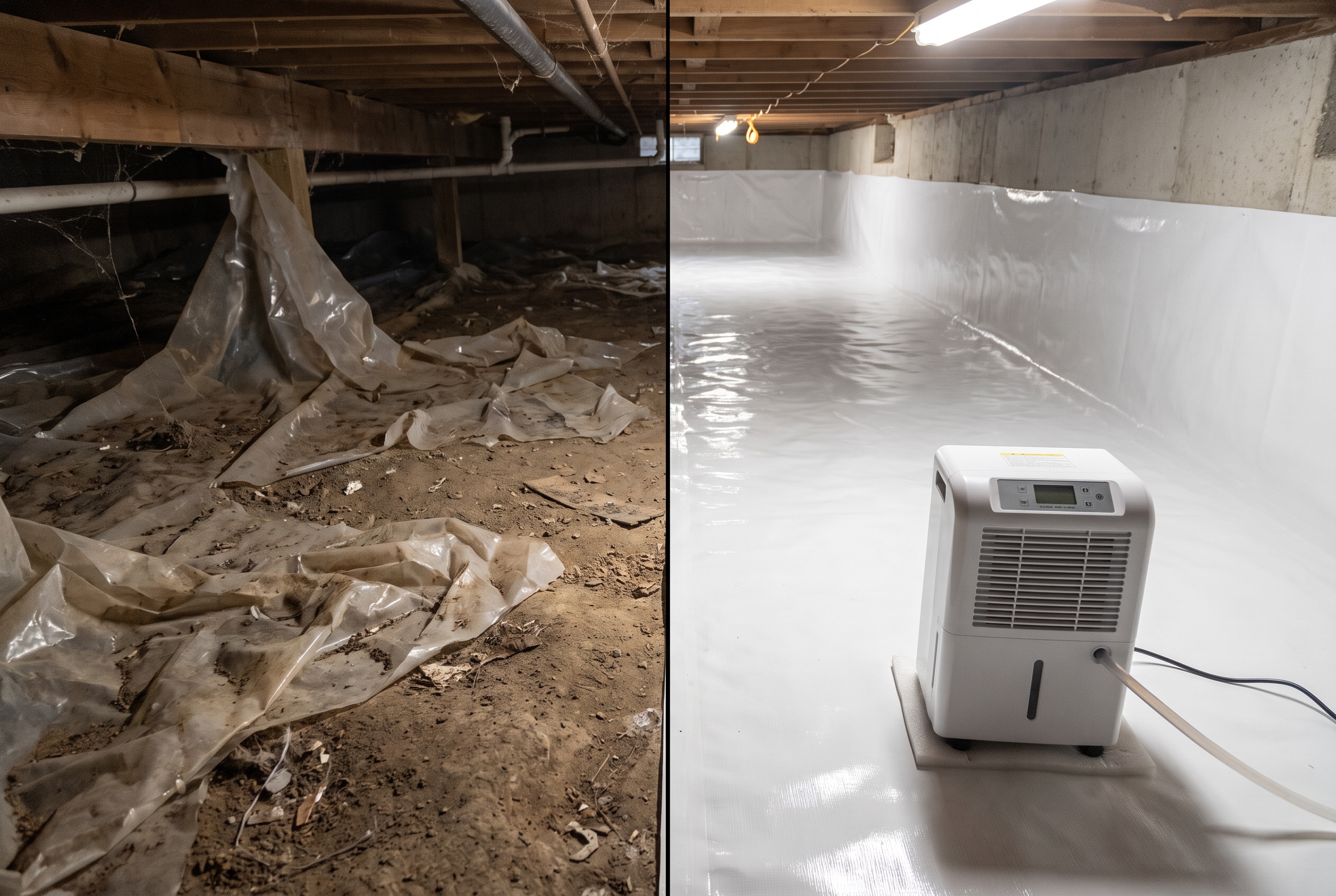
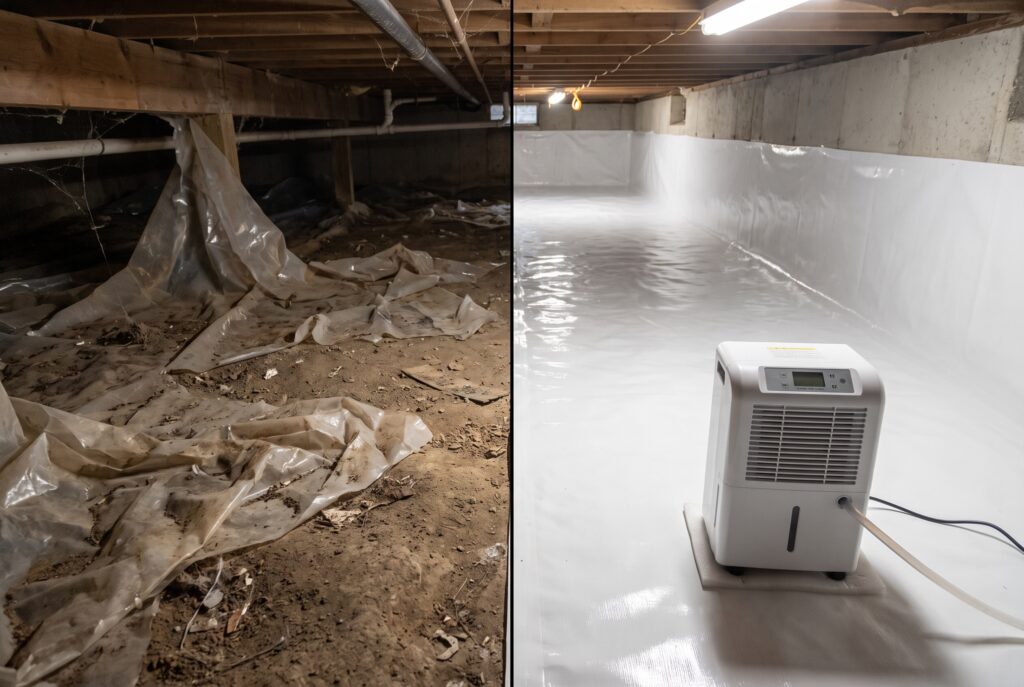
Crawl space encapsulation is a complete moisture management system. It includes a vapor barrier as its foundation, but it goes significantly further. A full encapsulation seals the ground and the foundation walls with a continuous heavy-duty liner, closes off the foundation vents so humid outdoor air can’t enter the space, and pairs the sealed environment with active dehumidification to maintain humidity at a level where mold and wood decay can’t establish. Some systems also include drainage components like a French drain or sump pump when water intrusion is part of the picture.
The simplest way to think about it: a vapor barrier addresses moisture coming up from the ground. Encapsulation addresses moisture coming from the ground, from the air, and from any other entry point, and then actively maintains the resulting environment. One is a passive partial measure. The other is a complete system.
What a Vapor Barrier Alone Can and Can’t Do
A properly installed vapor barrier does a real job. Soil moisture evaporates upward continuously, and without a barrier between the ground and the crawl space air, that vapor raises humidity levels even when there’s no standing water and no obvious moisture source. A quality liner covering the full ground surface blocks that vapor pathway and reduces the baseline moisture load in the space meaningfully.
What a vapor barrier can’t do is address the other ways moisture gets into a crawl space. Foundation vents, the ones built into most older crawl spaces under the assumption that airflow would keep things dry, let in outdoor air. In a climate like Hampton Roads, where summer air is hot and saturated with humidity, those vents are pumping moisture-laden air into the crawl space all season long. That air hits the cooler surfaces inside, loses its capacity to hold moisture, and deposits it on the joists, the liner, and everything else down there. A vapor barrier on the ground does nothing about that.
Similarly, a vapor barrier doesn’t address moisture entering through cracks in the foundation walls, around pipe penetrations, or rising up through the ground during periods of high water table. And it provides no active control: if conditions change, the humidity in the space changes with them, with no mechanism to bring it back down.
The EPA notes that controlling moisture at the source is the most effective strategy for preventing mold growth, and in a crawl space, the ground is only one of several moisture sources. A barrier that addresses the ground while leaving the others open is a partial solution at best.
When a Vapor Barrier Is Sufficient
There are situations where a vapor barrier alone is a reasonable answer, and being honest about that matters. Not every crawl space needs a full encapsulation, and a contractor who recommends the same complete system for every home regardless of conditions is worth a second look.
A vapor barrier replacement or upgrade makes sense when the existing moisture situation is genuinely limited to ground vapor, the foundation vents aren’t causing a significant condensation problem, there’s no history of water intrusion or standing water, the wood framing is in good condition with no signs of mold or rot, and the relative humidity in the space is elevated but not severely so. In that scenario, installing or replacing a quality liner, something in the 12-mil reinforced range rather than the minimum code-required 6-mil, addresses the primary moisture source without requiring the full system.
The catch is that this describes a smaller portion of Hampton Roads crawl spaces than most homeowners assume. The regional environment, high baseline humidity, a water table that rises after every significant storm, and foundation vents that were never well-suited to a coastal climate, means that a lot of crawl spaces here are dealing with moisture from multiple directions simultaneously. A vapor barrier in those conditions improves things without actually solving them.
When You Need Full Encapsulation
Full encapsulation is the right answer when the crawl space moisture problem goes beyond ground vapor. Specifically, if any of the following apply, a vapor barrier alone is unlikely to get the space to where it needs to be.
If the foundation vents are letting in humid summer air and causing condensation on the framing, sealing those vents is a necessary part of the fix. That’s encapsulation, not just a liner swap. If the relative humidity in the crawl space is consistently above 60 percent during warm months, active dehumidification is needed to bring it down and keep it there. A liner on the ground doesn’t accomplish that on its own.
If there’s any history of water intrusion, standing water after rain, or visible efflorescence on the foundation walls indicating water has been moving through them repeatedly, the moisture is coming from more than one direction. If the wood framing shows any signs of mold, dark staining, or soft spots, the moisture has already been elevated long enough to cause effects, and the environment that allowed that needs to be fully corrected, not partially improved.
For most homes in Chesapeake, Norfolk, Virginia Beach, and the surrounding area, full encapsulation is the more appropriate recommendation. The coastal Virginia environment is demanding enough that partial measures tend to slow the problem down rather than solve it. The Department of Energy’s guidance on crawl space performance supports the sealed, conditioned crawl space model specifically for humid climates where passive ventilation doesn’t work, which is an accurate description of this region.
The Components of a Complete Encapsulation System
Understanding what full encapsulation actually includes helps clarify why it performs differently than a vapor barrier alone.
The liner is the starting point. A proper encapsulation uses a reinforced polyethylene liner in the 12-mil range or heavier, covering the entire ground surface and running up and mechanically fastening to the foundation walls. All seams are lapped and taped so there’s no exposed soil or gap anywhere in the space. This is a meaningfully different installation than a loose sheet of 6-mil poly laid on the ground with the edges stopping at the wall.
The foundation vents are sealed. This is the step that separates encapsulation from vapor barrier installation more than anything else, and it’s the step that makes the approach work in a humid climate. With the vents closed, the crawl space becomes a controlled environment rather than one that’s constantly exchanging air with the outdoors.
A professional-grade dehumidifier is installed to actively manage humidity in the sealed space. Sized correctly for the square footage and moisture load of the specific crawl space, the unit maintains relative humidity below the threshold where mold and decay can establish, regardless of what outdoor conditions are doing. You can read more about how dehumidifier sizing and installation works in our post on crawl space dehumidifier installation.
Drainage components are added when water intrusion is part of the picture. A French drain around the perimeter, a sump pit, and a pump handle water that would otherwise accumulate in the space and undermine everything else the system is doing. Not every encapsulation requires drainage, but when the site conditions call for it, leaving it out means the rest of the system is working against an active water source.
How to Know Which One Your Crawl Space Needs
The honest answer is that you need someone to actually look at the crawl space before making that call. The condition of the existing vapor barrier if there is one, the humidity level, the state of the framing, whether there’s evidence of water intrusion, and what the foundation vents are doing to the moisture environment all factor into the right recommendation. Two homes in the same neighborhood can have different answers depending on what’s happening under each one.
What you can do in the meantime is think about the symptoms. If the crawl space has a musty smell, if the first floor of the house feels humid even with the AC running, if there are any soft spots in the flooring, if you’ve had water in the space after rain, or if the existing vapor barrier is old, torn, or incomplete, those are signs that conditions have gotten beyond what a simple liner replacement is likely to fix. You can read more about the specific crawl space encapsulation process and what a complete system looks like for Hampton Roads homes.
At Hawk we offer free crawl space inspections with no obligation. We’ll assess the moisture situation, the condition of the existing vapor barrier and framing, and give you a straight recommendation on whether a barrier replacement or a full encapsulation makes sense for your specific crawl space. Schedule your free inspection here.
Frequently Asked Questions
Is encapsulation worth the extra cost over a vapor barrier?
In most Hampton Roads crawl spaces, yes. The additional cost of sealing the vents and adding a dehumidifier is relatively modest compared to the total project cost, and it’s the difference between a system that actually controls the crawl space environment and one that partially improves it. A vapor barrier that doesn’t stop the moisture problem from continuing is money spent that doesn’t solve anything long-term. The right question is whether your crawl space has a moisture problem that a barrier alone can actually fix, and in most cases in this region, the answer is that it can’t.
Can I add encapsulation components to an existing vapor barrier?
Sometimes, but it depends on the condition of the existing liner. If the current vapor barrier is a quality product in good condition with no major tears or gaps, it may be possible to build on it by sealing the vents and adding a dehumidifier. More often, older vapor barriers in Hampton Roads crawl spaces are degraded enough that starting fresh with a new heavy-duty liner as part of a complete encapsulation is the better approach. A professional inspection will tell you which situation you’re in.
Will encapsulation fix my mold problem?
Encapsulation prevents mold from growing by removing the moisture conditions it needs. It does not remediate mold that’s already established on the framing. If there’s active mold in the crawl space, professional mold remediation needs to happen before or alongside the encapsulation work. Installing an encapsulation system over existing mold growth seals the problem in rather than solving it. You can read more about the remediation side of this in our post on crawl space mold removal.
How long does crawl space encapsulation last compared to a vapor barrier?
A properly installed encapsulation system using heavy-duty liner material should last significantly longer than a standard 6-mil vapor barrier. The liner itself, if it’s a quality reinforced product and isn’t subjected to repeated heavy foot traffic or mechanical damage, can last 20 years or more. The dehumidifier will need periodic maintenance and eventual replacement, typically in the ten to fifteen year range depending on the unit and conditions. A basic 6-mil vapor barrier in a Hampton Roads crawl space often degrades within a decade and may need replacement sooner in particularly demanding conditions.
Share with others

Contact Forever Guard Today!
Forever Guard will do everything we can to ensure your experience with us is excellent.