
Floor Joist Repair: What It Involves and When Your Home Needs It
If you’ve already had someone look at your crawl space, or you’ve gotten under there yourself, and the word “joists” came up, you’re past the point of wondering whether something is wrong. You’re trying to figure out how bad it is, what fixing it actually means, and what happens if you put it off. This post is aimed at that stage of the process.
Floor joist repair is more specific than general sagging floor work. The joists are the horizontal framing members that span between your foundation walls and support beams, and they carry the load of everything above them: the subfloor, the finish floor, the furniture, and the people walking around on it. When they’re compromised, the floor loses the support it needs, and the longer that goes unaddressed, the more the damage tends to spread.
What Damages Floor Joists in Coastal Virginia Homes
In Hampton Roads, the two most common culprits are moisture-driven wood decay and termite damage. Both are largely invisible until they’ve been developing for a while, and both are directly connected to crawl space conditions.
Wood rot and fungal decay. Wood rot isn’t caused by moisture directly. It’s caused by wood-destroying fungi that need sustained moisture to grow and spread. When a crawl space stays humid, whether because it’s unencapsulated, poorly vented, or dealing with groundwater intrusion, the framing above it stays damp. Over time that dampness creates exactly the environment those fungi need. The decay starts at the surface and works inward, progressively reducing the structural cross-section of the joist. A joist that looks intact from below might have lost a significant portion of its load-carrying capacity to internal decay.
Chesapeake and the surrounding area are particularly prone to this because of the region’s consistently high humidity and the high water table in many neighborhoods. Homes in low-lying areas near Deep Creek, Great Bridge, or coastal parts of Virginia Beach deal with moisture pressure that doesn’t let up seasonally the way it might in drier parts of the state.
Termite damage. Subterranean termites are common throughout Hampton Roads, and floor joists are a frequent target. They feed on wood from the inside out, hollowing out the interior while leaving the outer shell mostly intact. This is part of what makes termite damage so insidious in a crawl space context: a joist can look fine from a quick visual inspection while being structurally hollow. The EPA notes that termite damage in the U.S. causes billions of dollars in structural damage annually, much of it in crawl space framing that goes uninspected for years. By the time floors start showing symptoms, the damage is usually well established.
Improper modifications. This one is less common but worth mentioning. Notches and holes cut into joists for plumbing or electrical runs, done without following proper guidelines, can significantly weaken them. A joist notched too deeply at midspan loses a disproportionate amount of its bending strength. If previous work was done under the house without much care for the framing, that’s sometimes part of what an inspection turns up.
How to Tell If Your Floor Joists Need Attention
Some of these signs overlap with general sagging floor symptoms, but a few point more specifically toward joist-level damage rather than failing support posts or foundation issues.
Floors that feel soft or spongy in a specific area, particularly if the subfloor material itself feels like it has some give, often indicate joist damage in that zone. The subfloor is only as solid as the joists beneath it. A floor that bounces noticeably when you walk across it, especially in an older home that didn’t always feel that way, is worth investigating.
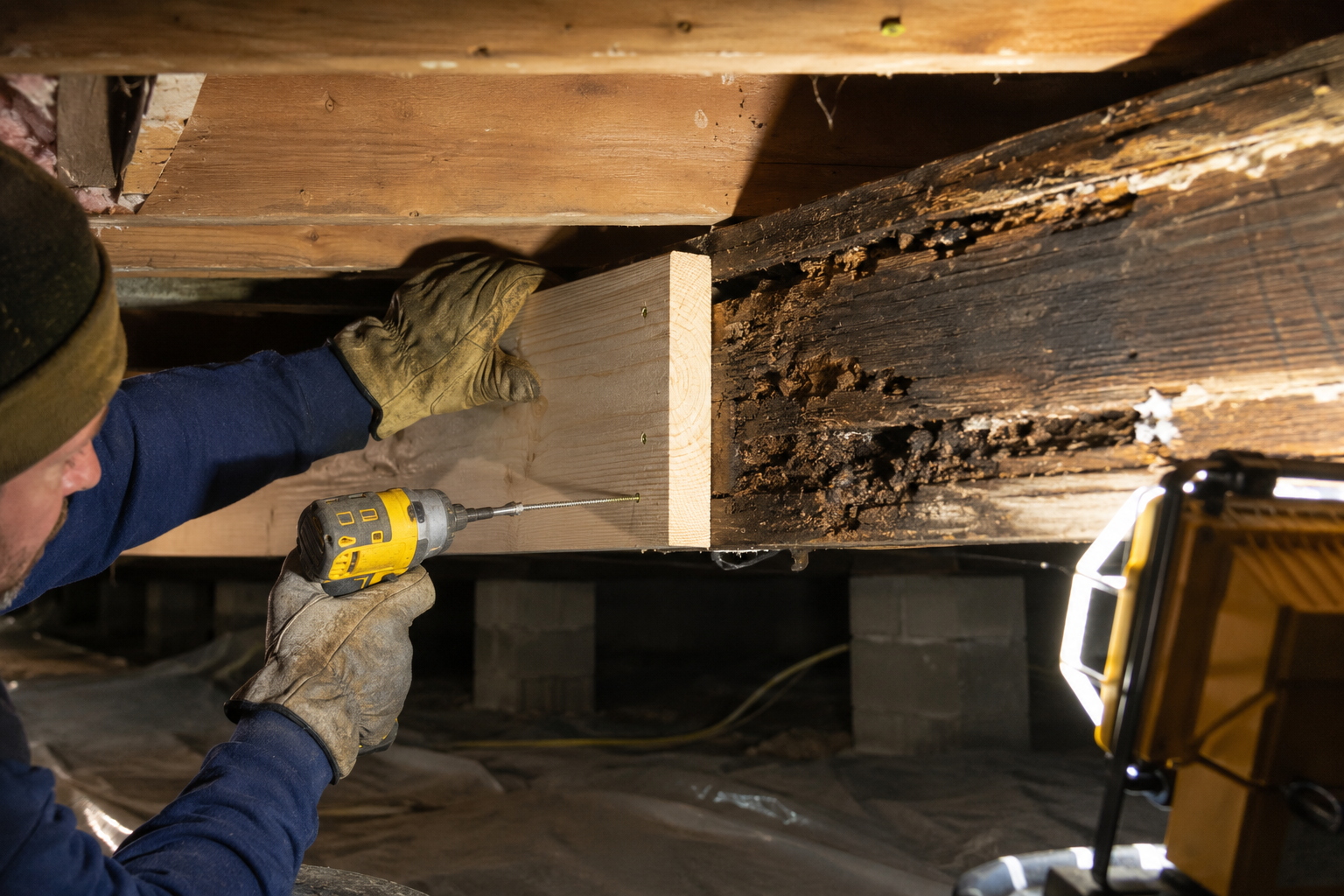
Visible damage during a crawl space inspection is the most direct indicator. Joists with dark staining, a soft or crumbling surface texture, obvious checking or splitting along the grain, or hollowed sections where termites have been active are all clear signs of compromised framing. A screwdriver test is a common field method: if a probe can be pushed into the wood with minimal resistance, the wood has lost structural integrity regardless of how it looks from the outside.
Squeaky floors that have gotten noticeably worse over time, as opposed to the occasional squeak that’s always been there, can also point to movement in the framing below. As joists weaken and deflect more under load, the connections between subfloor and framing start to work loose.
What Floor Joist Repair Actually Involves
The right approach depends on how much of the joist is damaged and how many joists are affected. There’s a spectrum of options, and a thorough inspection is what determines where on that spectrum your situation falls.
Sistering. When a joist has localized damage that doesn’t run its full length, sistering is often the preferred repair. A new joist of the same dimensions gets fastened alongside the damaged one, spanning the full length from bearing point to bearing point. The new joist carries the load the damaged one can no longer handle. This is a relatively efficient repair when the damage is limited and the surrounding framing is in decent shape. The key is that the sister joist has to make full contact at both ends where it bears on the beam or foundation wall, otherwise the repair doesn’t transfer load the way it needs to.
Full joist replacement. When a joist is damaged along most of its length, or when termite damage has hollowed out the core, sistering isn’t sufficient. The damaged joist has to be removed entirely and replaced with new material. This is more labor-intensive, especially in tight crawl spaces, but it’s the right call when the original framing is too far gone to be supplemented.
Replacing sill plates and rim joists. The sill plate is the piece of wood that sits directly on top of the foundation wall, and the rim joist runs along the perimeter of the floor system. Both are highly exposed to moisture and are common sites for rot and termite damage. When these members are compromised, they affect the entire floor system because every joist ultimately bears on them. Replacing sill plates and rim joists is detailed work but often necessary before the rest of the floor framing can be properly supported. You can see more about the full scope of crawl space structural repair services we provide.
Addressing the cause alongside the repair. This point is worth repeating because it’s where a lot of repairs fall short. New framing installed in a wet, uncontrolled crawl space is going to face the same conditions that damaged the original framing. A proper floor joist repair in a Hampton Roads home almost always needs to be paired with moisture remediation: crawl space encapsulation, improved drainage, a dehumidifier, or some combination. The structural work and the environmental work belong in the same project scope. The U.S. Department of Energy recognizes that sealing and conditioning a crawl space is one of the more impactful steps a homeowner can take for both energy efficiency and long-term structural performance.
Getting a Clear Picture of What You’re Working With
Floor joist damage isn’t something that tends to sit still. Moisture and termites don’t stop because a repair hasn’t been scheduled yet, and framing that’s already weakened is more vulnerable to further damage. The practical implication is that getting an inspection sooner rather than later usually means a smaller scope of repair and a lower cost.
At Hawk, we offer free crawl space inspections with no obligation. We’ll get under the house, document what we find, and give you a straight assessment of what’s there and what we’d recommend. You don’t need to be home for us to take a look. Reach out here to schedule yours.
Frequently Asked Questions
How many floor joists need to be damaged before it becomes a serious problem?
There’s no clean threshold, because it depends on which joists are damaged and how severely. A single joist with significant rot in a high-load area, directly beneath a load-bearing wall or a heavy fixture, can be more consequential than several joists with minor surface damage in a low-traffic area. The severity of the damage matters as much as the count. An inspection that maps out where the damage is and how deep it goes gives you a much clearer picture than a number alone.
Can floor joists be repaired without replacing the subfloor?
Often yes. Joist repair or sistering happens from below, in the crawl space, and in many cases the subfloor above doesn’t need to be disturbed. If the subfloor itself has been damaged by the same moisture that got the joists, that’s a separate issue that might need to be addressed from above, but it’s evaluated independently. A good inspection will tell you whether the damage is limited to the framing or whether it extends into the subfloor material as well.
Is floor joist repair covered by homeowner’s insurance?
Generally not, unless the damage was caused by a specific covered event like a burst pipe. Damage from long-term moisture, wood rot, or termites is typically treated as a maintenance issue and excluded from standard homeowner’s policies. It’s worth reviewing your specific policy and asking your insurer directly, but most homeowners in this situation are paying out of pocket. That’s another reason catching it early, before the scope has grown, tends to make a meaningful difference in overall cost.
What’s the difference between floor joist repair and sagging floor repair?
They overlap significantly but aren’t identical. Sagging floor repair is the broader category and includes issues with support posts, beams, and foundation conditions, not just the joists themselves. Floor joist repair specifically addresses damage to the horizontal framing members that span between supports. In practice, a sagging floor is often caused at least in part by joist damage, but it can also be caused by failing posts or inadequate support with joists that are otherwise in fine shape. An inspection is what tells you which you’re actually dealing with. If you want more context on the broader picture, our sagging floor repair blog post covers what that scope of work typically looks like.